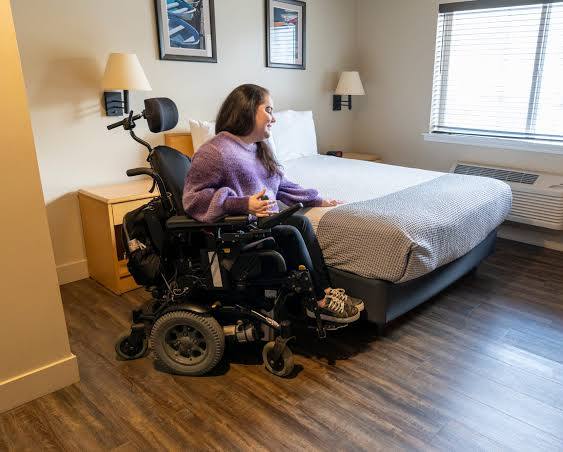
Researching an accessible hotel requires more than filtering for an “accessible room.” The most reliable process identifies the traveler’s specific access requirements, checks official property descriptions against relevant standards, confirms critical features directly with the property, and records reservation details so the room and route can be verified before arrival.
TL;DR: For U.S. travel, use ADA.gov lodging guidance and the u.s. access board’s ADA standards to understand formal accessibility requirements, then verify the features of the specific property and room. The Department of Justice’s hotel reservation enforcement work also shows why accurate accessible-room information matters. Accessibility rules vary by country and jurisdiction, so treat legal sources as location-specific and do not assume that an “accessible” label describes the same features everywhere.
Start with the traveler, not the checkbox
Accessibility needs are individual. Two guests who use the same broad category of mobility, vision, hearing, cognitive, or sensory support may need different room layouts or services. The research process should therefore begin with a short list of functional requirements rather than a generic label.
Examples of questions a traveler may choose to verify include entrance step-free access, elevator access, door clearance, bed transfer space, bathroom layout, shower type, grab-bar configuration, visual or audible alarms, accessible parking, pool access, restaurant routes, or the ability to accommodate a service animal where applicable.
Do not assume that every traveler needs all of these features. The point of a requirements list is precision and autonomy: the traveler decides what is essential, preferred, or irrelevant.
| Feature area | What to verify | Good evidence | Why confirmation matters |
|---|---|---|---|
| Reservation | Exact accessible room type and features | Official booking page plus direct property confirmation | A generic accessibility icon may not describe the booked room |
| Route | Step-free path from arrival point to room and key amenities | Property accessibility statement, floor information, direct confirmation | One accessible room does not prove every route is accessible |
| Bathroom | Shower type, seat, grab bars, clear space, fixtures | Detailed room description, official photos, property confirmation | Bathroom layouts vary widely |
| Communication | Visual alarms, notification devices, phone or door alerts | Property feature list and staff confirmation | Equipment may be room-specific or available on request |
| Amenities | Pool, spa, beach, restaurant, meeting space, shuttle | Official amenity accessibility information | Public areas can have different barriers than guestrooms |
Use standards to know what questions to ask
The U.S. Access Board publishes the ADA Accessibility Standards and technical guidance. For transient lodging, the standards contain requirements for accessible guest rooms and communication features. Travelers do not need to become code experts, but the standards help researchers move from vague language to concrete features.
ADA.gov’s lodging guidance also provides practical information for serving guests who are blind or have low vision, including communication, wayfinding, signage, and service practices. These resources describe U.S. requirements and guidance; they should not be presented as global rules.
When terminology is confusing, the site’s hotel terminology resources can help separate property-type language, room terms, and operating terminology. For accessibility research, however, official legal and technical definitions should take priority over informal travel vocabulary.
Read the property page for specifics, then verify essentials
A useful hotel accessibility page should describe features, not merely declare that the property is accessible. Look for room-level detail, accessible routes, parking, elevators, communication features, bathroom configurations, and public-area information.
Photographs can help with orientation, but they are not measurements unless dimensions are explicitly provided by a reliable source. Wide-angle photography can also distort space. If a dimension or feature is essential, ask the property directly and request a specific answer.
A confirmation call or written message can use a concise script: state the booked room type, identify the feature that must be present, ask staff to confirm it in the property or reservation system, and record the name or channel used. Avoid asking staff to judge whether the room will “work” for the traveler. Ask them to confirm observable features instead.
Understand why reservation accuracy matters
The U.S. Department of Justice has enforced ADA requirements involving accessible hotel reservations. In a 2024 agreement with Marriott International, the DOJ described steps related to accurate accessible-room inventory and reservation information across booking channels. That is a useful reminder that reservation accessibility is not only about the physical room; the information and booking process also matter.
For travelers, the practical lesson is to save the reservation confirmation and any written accessibility details. If the booking platform uses a generic room label, contact the property before arrival and ask for the exact room features to be noted.

Research the full stay, not just the bed and bathroom
A room can meet a traveler’s core needs while the rest of the stay remains difficult. Map the journey from arrival through departure:
1. Arrival point, parking, drop-off, or public transport connection.
2. Entrance and check-in route.
3. Elevator or corridor route to the room.
4. Room and bathroom features.
5. Restaurant, breakfast, lounge, meeting, fitness, pool, spa, beach, or other amenities the traveler plans to use.
6. Emergency communication and evacuation information.
7. Departure transport and luggage assistance if needed.
This journey map can expose a single critical gap, such as an accessible pool with no accessible route from the guestroom building, or an accessible room in a property whose shuttle cannot accommodate the traveler’s mobility device.
Use design resources as a secondary lens
Accessibility and wellness design overlap in areas such as wayfinding, lighting, acoustics, seating, circulation, and sensory comfort, but they are not interchangeable. A beautiful biophilic lobby is not proof of compliance with accessibility standards, and a code-compliant space may still present usability challenges for a particular traveler.
The site’s biophilic and wellness design resource guide can be useful after essential access requirements are verified. It provides a separate framework for evaluating comfort and environmental experience without treating subjective wellness features as substitutes for access.
Evaluate technology for both convenience and fallback
Digital check-in, mobile keys, chat, kiosks, smart-room controls, and accessibility features can make a stay easier for some guests. They can also create barriers if the interface is inaccessible or the hotel removes a staffed alternative.
When researching a technology-enabled hotel, ask what the fallback process is. Can a guest check in with staff if the kiosk is difficult to use? Are room controls available physically as well as through an app? Can a traveler request communication support without relying on one channel?
Readers following these changes can use the site’s hospitality innovation resources to evaluate whether a capability is a documented hotel workflow or simply a product claim.
Keep an accessibility verification record
For a trip where specific features are essential, create a short record with the property, dates, room type, confirmation number, required features, source page, date checked, and direct confirmation. Add notes on public areas or transport if those affect the stay.
This record is particularly useful when reservations are changed, rebooked, or moved between room types. Reconfirm critical features after any modification instead of assuming the new reservation preserved them.
Choose evidence over labels
The strongest accessibility research is specific, current, and traveler-led. Use official standards to understand requirements, hotel information to identify available features, and direct confirmation for the details that are essential to the trip. Reviews from other travelers can add perspective, but one person’s experience cannot guarantee that a property will meet another person’s needs.
The next practical step is to write a five-item “must verify” list for the actual stay. Check those items against the property page, then contact the hotel for any detail that remains unclear. That focused process is usually more reliable than searching for a property described only as “accessible.”