Cluster: DIY Repairs & Home Improvement | Content Type: Comparison | Search Intent: Commercial Investigation | Audience: Solution-Aware | Funnel: Middle of Funnel
A DIY-friendly floor is not simply the material with the lowest price tag. The best fit depends on how flat and dry the subfloor is, how much cutting and layout work you are comfortable doing, what the room is exposed to, and how forgiving you need the installation to be.
TL;DR Click-lock laminate and many floating vinyl plank systems are usually the easiest starting points for careful DIYers because they avoid mortar and grout. Tile can be a durable, water-tolerant choice, but it asks more of the installer: substrate preparation, layout, cutting, setting, grouting, and cure time all matter. Product instructions always control, and room conditions can change the answer.
Start With the Installation System, Not the Look
The visual category can hide major installation differences. "Vinyl" may mean glue-down luxury vinyl tile, flexible click-lock planks, or rigid-core floating products. Laminate is commonly installed as a floating click-lock floor, but edge sealing, underlayment, and moisture requirements vary by product. Tile typically needs a rigid, properly prepared base plus mortar and grout. The Resilient Floor Covering Institute's overview of resilient flooring is useful for understanding how many constructions sit under the vinyl label, while NALFA's laminate guidance emphasizes the importance of a suitable subfloor.
For a first project, read the installation manual before buying. If the instructions call for floor flattening, moisture testing, special adhesives, expansion space, or a specific underlayment, those tasks belong in the project budget and timeline.
Quick Comparison for a Hands-On Homeowner
| Factor | Tile | Vinyl | Laminate |
|---|---|---|---|
| DIY learning curve | Highest of the three for most beginners | Often moderate, especially floating planks | Often moderate with click-lock systems |
| Water exposure | Material can tolerate water, but the full assembly must be correctly built | Varies by construction; many products are designed for moisture-prone rooms | Water resistance varies by product and edge treatment |
| Subfloor demands | Very sensitive to movement and flatness | Flatness still matters; some products are more forgiving | Flatness and dryness are important for joint performance |
| Repairs | Individual tile replacement is possible but messy | Plank replacement method depends on installation type | Board replacement is possible but may require disassembly |
| Feel underfoot | Hard and cool without radiant heat | Usually softer and quieter than tile | Typically warmer-feeling than tile |
These are broad comparisons, not performance guarantees. Tile Council of North America resources show why tile installation is a system rather than just a surface material.
Where Tile Makes Sense for a DIY Project
Tile suits a homeowner who values a hard, durable surface and is willing to spend time on preparation. The challenge is not only setting pieces in straight lines. You may need to correct subfloor deflection or flatness, plan movement joints, make clean cuts around jambs and fixtures, and keep mortar coverage consistent. A small powder room or entry can be a more manageable first tile job than a large open-plan floor.
Tile also rewards patience. Layout mistakes become obvious at walls, doorways, and transitions. Dry-laying key rows before mixing mortar can expose awkward slivers and alignment problems. If the substrate is questionable, waterproofing is required, or the tile is unusually large or heavy, professional installation may be the safer choice.
Where Vinyl Is the Most Forgiving
Floating vinyl plank is popular with DIYers because many products click together and can be cut with relatively simple tools. It can also work well in busy households because cleaning is straightforward and many constructions are designed for moisture resistance. That does not mean every vinyl floor is interchangeable. Flexible planks can telegraph imperfections below them, rigid-core products have their own expansion and temperature rules, and glue-down systems require careful adhesive work.
If you are already planning electronics and furniture placement, the article on improving Wi-Fi coverage in a larger home can help you think through router and cable locations before heavy furniture returns to the room. Finishing those details before the final move-in can reduce unnecessary lifting over a new surface.
Where Laminate Offers a Strong Middle Ground
Laminate can be a practical choice when you want a wood-look floor, a floating installation, and a surface built to handle ordinary household wear. The key limitation is that moisture performance is product-specific. Some modern laminate products have enhanced water resistance, but installation details around edges, doorways, kitchens, and bathrooms still matter. Do not assume a general "waterproof" marketing phrase replaces the written warranty or installation guide.
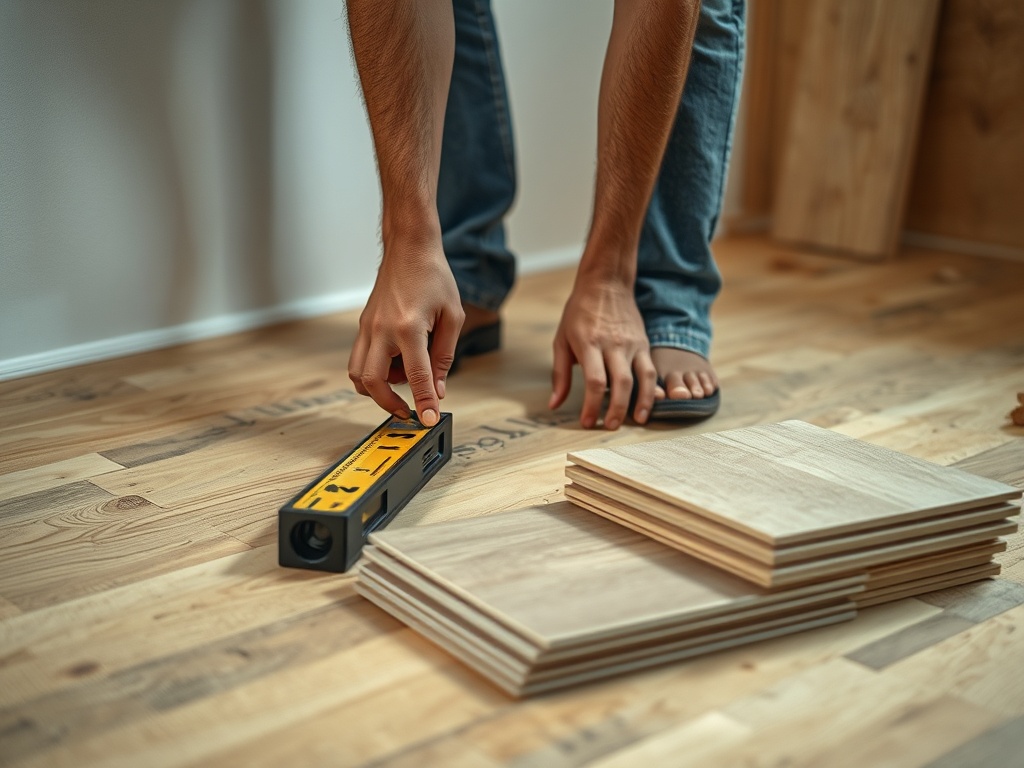
Laminate also needs room to move. Expansion gaps, acclimation requirements, and transitions across long runs differ by manufacturer. A tightly pinched floating floor can buckle or separate. Careful measuring, undercutting door casings where appropriate, and staggering end joints make a bigger difference than rushing to cover square footage.
Cost Is More Than the Box Price
Material cost is only one line in a DIY flooring budget. Add underlayment or membrane, leveling compounds, moisture barriers, trim, transitions, blades, spacers, adhesives, grout, sealers where required, disposal, and a reasonable overage for cuts or damaged pieces. Tile may require more specialized tools. Vinyl and laminate may look cheaper to install yourself, but a badly uneven subfloor can erase that advantage if preparation is skipped.
Maintenance also affects long-term value. Tile grout may need more attention than a click-lock floor. Vinyl can be damaged by sharp loads or unsuitable cleaning products. Laminate joints can suffer if water is allowed to sit where the product is not designed for it. Choose based on the room you actually have, not a showroom sample.
A Simple Decision Framework
Choose tile when you are comfortable with a slower, more technical installation and want a hard surface suited to the room's conditions. Choose vinyl when easy cleaning, a relatively approachable floating installation, and moisture-tolerant options are high priorities. Choose laminate when you want a convincing wood-oriented look and click-lock installation while accepting the product's specific moisture rules.
Then ask four final questions: Is the subfloor flat enough? Are moisture conditions understood? Can you make the required cuts safely? Will the floor transition cleanly into adjacent rooms? If any answer is uncertain, solve that issue before purchase.
Flooring work often exposes other improvement opportunities. Before reinstalling trim and furniture, review ways to secure sliding doors and basement windows if the room connects to a vulnerable exterior opening, and use storage-bin and labeling ideas to keep tools, leftover planks, grout, or spare tiles organized for future repairs.
Make the Floor Choice Fit the Room
The most DIY-friendly option is the one whose preparation, cutting, moisture rules, and finishing details match your skills and the room. Compare installation manuals side by side before buying, inspect the subfloor carefully, and price the complete system rather than only the surface material.
This home-improvement content is for informational and educational purposes only and is not a substitute for professional flooring, structural, electrical, or building-code advice. Follow product instructions and applicable local requirements.